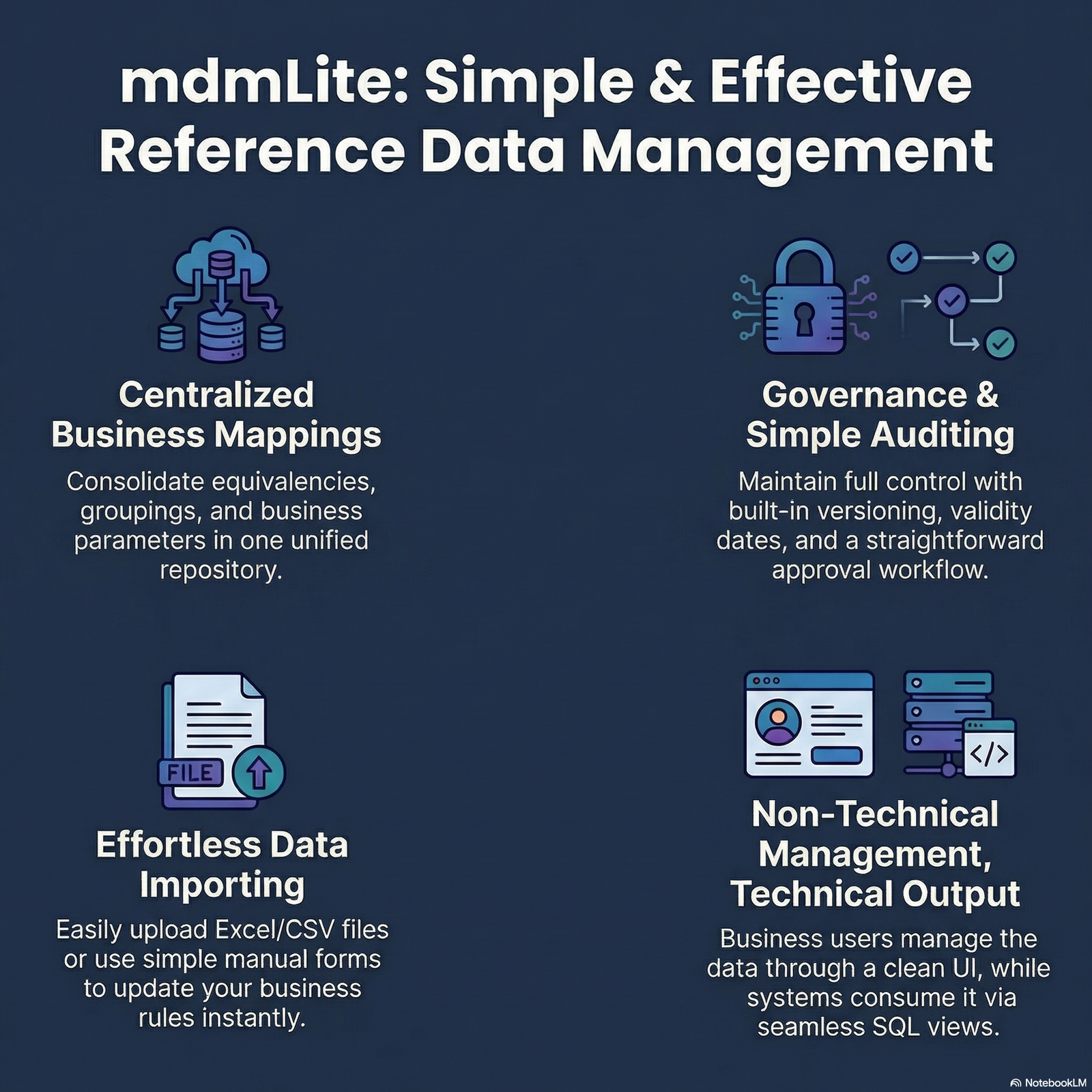
MDM Lite is a lightweight operational reference data product for business rules that should not remain hardcoded in ETL, ELT, notebooks, dashboards, or support spreadsheets. It centralizes mappings, groups, and parameters so humans can maintain them, downstream systems can consume them, and delivery teams can govern them without heavyweight MDM overhead.
Stop rule sprawlReplace CASE statements, CSV lookups, and hardcoded dictionaries with one operational source of truth.
Control change safelyUse approvals, non-destructive updates, and audit history instead of overwriting rules in place.
Feed delivery toolsExpose stable active views for SQL, Python, dbt, notebooks, and other downstream consumers.
Try It On Windows
Download the Windows trial package and run it on your own PostgreSQL.
The trial package is a self-contained ZIP for Windows operators. It installs MDM Lite on a customer-owned PostgreSQL database with approval workflow, audit trail, and stable downstream views ready to use.
Controlled trial scope. The package is intended for customer-hosted environments and an operator with admin rights. If the direct download is not available in your network, request the package by email.
Install in 5 steps
Unzip mdm-lite-windows-trial.zip into a local folder, for example C:\apps\mdm-lite.
Open LEER-PRIMERO-INSTALACION.md at the package root.
Run scripts\windows\configure-production.bat to set DATABASE_URL, admin user, and port.
Run scripts\windows\check-db-connection.bat to validate PostgreSQL connectivity.
Run scripts\windows\install-and-start.bat and open http://127.0.0.1:3003.
After install, run scripts\windows\smoke-test.bat to confirm the home and /api/health/db respond.
Problem
Business rules are often scattered across fragile places.
In many analytics and modernization programs, small but critical business rules live in Excel files, CSVs, ad hoc lookup tables, repeated SQL CASE statements, Python dictionaries, or manual dashboard logic. That creates duplication, weak traceability, and unnecessary change cost.
Spreadsheet governance with no approval trail.
Hardcoded rules embedded in pipelines, notebooks, and reports.
Duplicate mappings copied from one technical asset to another.
No clear answer to who changed a rule, when, or why.
Boundary
MDM Lite is intentionally focused.
It is a lightweight administrative product over PostgreSQL for reference rules, not a giant enterprise MDM suite. The goal is controlled operational governance for simple but high-impact rules.
Operational store for mappings, groups, and parameters.
Stable technical contract for downstream read access.
Not a golden record or survivorship engine.
Not a replacement for catalogs, lineage tools, or orchestration platforms.
Mappings
Govern source values to canonical target values so transformations stop carrying repeated normalization logic in code.
Groups
Manage business group membership rules for reporting, segmentation, and downstream enrichment without copy-paste maintenance.
Parameters
Control scoped key-value business parameters with validity windows and operational traceability.
Operating Model
Simple governance that delivery teams can actually use.
MDM Lite is designed for gradual governance. It keeps the workflow clear, auditable, and easy to adopt instead of forcing a heavyweight enterprise operating model from day one.
1
Capture or import candidate rules
Rules can be entered manually or loaded through guided import flows with validation, preview, error reporting, and batch summary.
2
Review, approve, and preserve history
Approved records do not need destructive overwrite semantics. Old records can be inactivated while the audit trail keeps actor, decision, and timestamp context.
3
Expose stable active-read contracts
Downstreams consume active views instead of coupling directly to internal write tables, which keeps the integration surface predictable.
4
Operate with lightweight control
Approval queues, audit visibility, pagination, filters, and import review create enough governance for real delivery teams without enterprise-platform drag.
End-to-end flow
From scattered rules to governed downstream contract.
Candidate rules enter MDM Lite from spreadsheets, code, or guided imports, get reviewed and approved, and become stable active views that downstream tools can trust.
Source rules MDM Lite governance Stable downstream contract
Record lifecycle
Non-destructive change with full audit trail.
Records move through a controlled lifecycle. Old versions are inactivated rather than overwritten, so the active read contract stays clean while history remains queryable.
Lower change cost
Business rule updates stop requiring repeated edits across SQL, Python, notebooks, dashboards, and support files.
Safer operational control
Approval workflow, future-dated changes, and audit history reduce the risk of silent rule drift.
Portable downstream consumption
Teams can read the same rule set from SQL, dbt, Python, or notebooks without locking themselves to one vendor stack.
Technical Contract
Built for downstream systems, not just human screens.
The preferred consumption model is stable active views. Downstream tools read the current approved, active, and valid rules without needing to understand internal workflow tables.
Only approved recordsOnly active recordsOnly currently valid records
This keeps the operational boundary clean: MDM Lite manages rule lifecycle, while transformation tools apply those rules where they belong.
vw_mdm_mapping_rule_active
vw_mdm_group_rule_active
vw_mdm_parameter_active
# Typical consumers
- SQL transformations
- dbt models
- Python and notebook jobs
- validation routines
- reporting logic that should not hardcode reference rules
Positioning
Where MDM Lite fits inside a modernization portfolio.
MDM Lite is the governed destination for reusable rule candidates and reference data that delivery teams need every day. It is intentionally lighter than enterprise MDM and more operational than documentation-only governance tools.
Versus dbt and pipelines
dbt or pipelines apply business rules. MDM Lite stores and governs the rules those technical assets should consume.
Versus enterprise MDM suites
Enterprise MDM goes broader and heavier. MDM Lite focuses on fast adoption for reference rules where operational clarity matters more than full-blown master data governance.
Versus catalogs and lineage platforms
Catalogs describe and govern assets. MDM Lite governs the operational rules those assets must apply.
Relationship with Legacy2Lake
Legacy2Lake can evolve upstream discovery and candidate extraction. MDM Lite remains the governed destination where teams review, approve, and operate reusable rules.
Why It Matters
MDM Lite gives delivery teams a controlled place to keep the rules that usually live nowhere well.
That means fewer brittle workarounds, cleaner downstream consumption, faster change cycles, and a governance posture that is strong enough to matter without becoming program drag.